
Understand MMPI Test Results: A Simple Guide to Your MMPI-2 Profile
If you have taken an MMPI-2 test and received your results, you may be looking at a page full of numbers, letters, scales and graphs and wondering what they all mean. The MMPI-2 does not give you one simple score. Instead, it creates a profile made up of many different scores, with each score providing a different piece of information about your answers.
This guide explains how to understand MMPI test results in simple terms, including T-scores, validity scales, Clinical Scales, RC Scales and the overall MMPI profile. The goal is to help you understand what the different parts of your results represent without requiring a background in psychology.
Important: An MMPI result is not simply a list of diagnoses. A high score on one scale does not automatically mean that you have a particular mental health condition.
What Are MMPI Test Results?
Your MMPI test results are the scores produced from your answers to the MMPI-2 questions. The standard MMPI-2 contains 567 True or False questions, and your responses are used to produce scores on many different scales.
Instead of giving you one overall personality score, the MMPI creates a profile. Think of the profile like a dashboard in a car. One gauge does not tell you everything about the car, so you need to look at several gauges together to understand what is happening. The same basic idea applies to MMPI test results.
Understanding MMPI test results therefore involves looking at how the different scores relate to one another rather than focusing on one number.
What Does an MMPI-2 Profile Look Like?
An MMPI profile usually contains a number of scores, often displayed in a table or graph. You may see validity scales, Clinical Scales, RC Scales, Content Scales and other measures, depending on the type of report that has been produced.
A simplified example might look like this:
| Scale | T-Score | General description |
|---|---|---|
| Validity Scale | 52 | Within the usual range |
| Clinical Scale 1 | 58 | Not particularly elevated |
| Clinical Scale 2 | 67 | Elevated |
| Clinical Scale 7 | 61 | Somewhat elevated |
| RC Scale | 64 | Relatively elevated |
These numbers are only an example and are not an actual psychological profile. The important point is that you should not simply look for the biggest number and assume that it explains your personality or mental health. The overall pattern is much more important.
Understanding MMPI T-Scores
One of the first things you will notice on an MMPI report is the letter T followed by a number, such as T-score 45, 52, 60 or 70. These are called T-scores, and they are simply a standardized way of reporting your result.
Using standardized scores makes it easier to compare results across the different MMPI scales. A T-score is not a percentage and does not mean that you have a certain percentage of a personality characteristic or psychological problem.
What Does a T-Score of 50 Mean?
A score around 50 represents the center of the standard scoring system. Scores above 50 are progressively higher, while scores below 50 are progressively lower.
For example, a score of 55 is higher than 50, while a score of 45 is lower than 50. This does not mean that one score is automatically good and the other is bad. The meaning depends on the particular scale and the rest of the profile.
What Does a 65 on the MMPI Mean?
You will often see 65 used as an important reference point on an MMPI-2 profile. A score at or above this level may be described as elevated.
However, a score of 65 does not mean that everyone with that score has a mental health disorder. The scale involved matters, as does the person’s complete profile, validity results and the reason the assessment was conducted.
What Does a Low MMPI Score Mean?
A low score is not automatically a good score. It simply means that your answers produced a relatively low result on that particular scale compared with the reference framework used by the test.
The meaning of a low score depends on what the particular scale measures. A low score on a Clinical Scale can have a very different meaning from a low score on a validity scale, so it is important not to assume that “low” always means something positive.
What Does a High MMPI Score Mean?
A high score means that your answers produced a relatively high result on a particular scale. It does not automatically mean that something is wrong or that you have a particular disorder.
For example, if one of your scales has a score of 70, you should not simply search for “MMPI 70 means” and assume that the answer describes you. It is important to know which scale produced the score, how high it is compared with the other scores, whether related scales are also elevated and whether the overall profile is valid.
This is why the MMPI is interpreted as a profile rather than as a collection of individual diagnoses.
1) Understanding the 10 MMPI Clinical Scales - Main Assessment Scales
The MMPI-2 includes the original 10 Clinical Scales. These are some of the best-known parts of the MMPI, but their names can be confusing because many of them use terminology from the period when the original MMPI was developed.
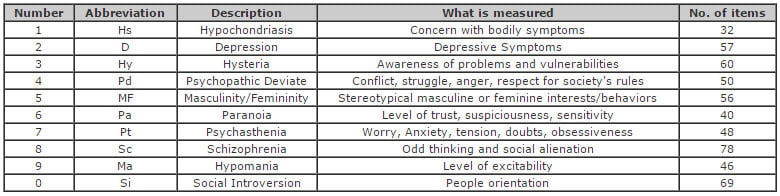
Number Abbreviation Description What is measured No. of items
1 Hs Hypochondriasis Concern with bodily symptoms 32
2 D Depression Depressive Symptoms 57
3 Hy Hysteria Awareness of problems and vulnerabilities 60
4 Pd Psychopathic Deviate Conflict, struggle, anger, respect for society’s rules 50
5 MF Masculinity/Femininity Stereotypical masculine or feminine interests/behaviors 56
6 Pa Paranoia Level of trust, suspiciousness, sensitivity 40
7 Pt Psychasthenia Worry, Anxiety, tension, doubts, obsessiveness 48
8 Sc Schizophrenia Odd thinking and social alienation 78
9 Ma Hypomania Level of excitability 46
0 Si Social Introversion People orientation 69
The validity scales in all versions of the MMPI-2 contain three basic types of validity measures: those that were designed to detect non-responding or inconsistent responding (CNS, VRIN, TRIN), those designed to detect when clients are over reporting or exaggerating the prevalence or severity of psychological symptoms (F, Fb, Fp, FBS), and those designed to detect when test-takers are under-reporting or downplaying psychological symptoms (L, K, S)).
Scale 1: Hypochondriasis
High Scorers: High scorers present excessive somatic symptoms that tend to be vague and undefined; for example, they may present epigastric complaints; fatigue, pain, weakness, and a lack of manifest anxiety. In addition, high scorers also show chronic personality features such as selfishness; self-centered and narcissistic behavior; and a pessimistic, defeatist, cynical outlook on life.
They tend to be dissatisfied and unhappy and may make others miserable through their whining and complaining. They are often demanding and critical of others and may express hostility indirectly. They rarely act out. They show long-standing health concerns and function at a reduced level of efficiency without major incapacity. They tend not to be open to therapy since they seek only medical solutions to problems.
Scale 2: Depression
High Scorers: High scorers on Scale 2 are described as being depressed, unhappy, and dysphoric; being pessimistic and self-deprecating; feeling guilty; feeling sluggish; having somatic complaints; feeling weak, fatigued, and lacking energy; acting agitated, tense, high-strung, and irritable; being prone to worry; lacking self-confidence; feeling useless and unable to function; feeling like a failure at school or on the job; being introverted, shy, retiring, timid, and seclusive; acting aloof; being psychologically distant; avoiding interpersonal involvement; being cautious and conventional; having difficulty making decisions; being non aggressive; acting over controlled, denying impulses; and making concessions to avoid conflict.
They tend to be motivated to seek therapy because of their distress. .
Scale 3: Hysteria
High Scorers: High scorers tend to react to stress and avoid responsibility through development of physical symptoms such as having headaches, chest pains, weakness, and tachycardia. Their symptoms often appear and disappear suddenly. These individuals tend to lack insight about causes of symptoms and their own motives and feelings. They tend to lack anxiety, tension, and depression and rarely report delusions, hallucinations, or suspiciousness.
They are viewed as psychologically immature, childish, and infantile; self-centered, narcissistic, and egocentric; attention-seeking and needing great affection from others. They tend to use indirect and devious means to get attention and affection. They are usually socially involved, friendly, talkative, and enthusiastic but superficial and immature in interpersonal relationships. They might be initially enthusiastic about treatment and may respond well to direct advice or suggestion, but show slow progress in gaining insight into the causes of their own behavior. They tend to be resistant to psychological interpretations. High Hy scores have been found to be associated with chronic pain and with compensation claims.
Scale 4: Psychopathic Deviate
High Scorers: High scorers are found to engage in antisocial behavior and are rebellious toward authority figures. They show stormy family relationships and usually blame others for their problems. They show a history of underachievement in school and a poor work history and may have marital problems. They are considered to be impulsive, and they strive for immediate gratification of impulses. They do not plan well and act without considering the consequences of their actions. They show impatience, limited frustration tolerance, poor judgment, and high risk- taking.
They do not appear to profit from experience. They are immature, childish, narcissistic, self-centered, and selfish. Their behavior is often described as ostentatious, exhibitionistic, and insensitive. They tend to be interested in others in terms of how they can be used. They are often thought to be likeable and usually create a good first impression but are shallow and superficial in relationships and unable to form warm attachments. They are described as extroverted, outgoing, talkative, active, energetic, spontaneous, intelligent, self-confident, hostile, aggressive, sarcastic, cynical, resentful, and rebellious. They tend to act out and have antagonistic behavior and aggressive outbursts. Some are assaultive and may show little guilt over negative behavior.
Scale 5: Masculinity–Femininity
MALES
High (T-score > 80): Men who attain high scores on this scale show conflict about sexual identity. They are insecure in their masculine role; are effeminate; have aesthetic and artistic interests; are intelligent and capable; value cognitive pursuits; are ambitious, competitive, and persevering; are clever, clear-thinking, organized, and logical; and show good judgment and common sense. They are curious; creative, imaginative, and individualistic in their approach to problems; sociable; sensitive to others; tolerant; capable of expressing warm feelings toward others; and passive, dependent, submissive, and peace-loving. They make concessions to avoid confrontations. They have good self- control and they rarely act out.
High Scorers (T-score 70–79): Males in this range on the Masculinity-Femininity scale may be viewed as sensitive, insightful, tolerant, effeminate, broad in cultural interests, submissive, and passive. (In clinical settings, the patient might show sex role confusion or heterosexual adjustment problems.)
Low Scorers (T-score < 35): Men who score low on this scale are often viewed as having a “macho” self-image. They present themselves as extremely masculine; strong and physically adept, aggressive, thrill-seeking, adventurous, and reckless; coarse, crude, and vulgar; and doubtful about their own masculinity. They have a narrow range of interests, an inflexible and unoriginal approach to problems, and seem to prefer action to thought.
FEMALES
High Scorers (T-score > 70): Females who score high on this scale tend to reject traditional female roles and activities. They show masculine interests in work, sports, and hobbies. They are described as active, vigorous, and assertive; competitive, aggressive, and dominating; coarse, rough, and tough; outgoing, uninhibited, and self-confident; easy-going, relaxed, and balanced; logical and calculated; and unemotional and unfriendly.
Low Scorers (T-score < 35): These women describe themselves in terms of the stereotyped female role and show doubts about their own femininity. They tend to be passive, submissive, and yielding in relationships. They defer to males in decision- making. They may show self-pity through complaining and/or fault-finding. They are seen as constricted, sensitive, modest, and idealistic.
Scale 6: Paranoia
Extremely High Elevations (T-score > 80): High scorers may show frankly psychotic behavior, disturbed thinking, delusions of persecution and/or grandeur, and ideas of reference. They feel mistreated and picked on and angry and resentful. They harbor grudges, use projection as a defense, and are most frequently diagnosed as schizophrenic or paranoid.
Moderate Elevations (T-score = 65–79 for males; T-score = 71–79 for females): In this range, individuals show a paranoid predisposition. They are sensitive and overly responsive to reactions of others, they feel they are getting a raw deal from life, and they rationalize and blame others. These individuals are likely to be suspicious and guarded, hostile, resentful, and argumentative. They tend to be moralistic and rigid, and they overemphasize rationality. They are poor therapy risks because they do not like to talk about emotional problems and have difficulty in establishing rapport with therapists.
Extremely Low Scorers (T-score < 35): In some settings, low paranoia scores (in the context of a defensive response set) may suggest potentially psychotic disorders such as delusions, suspiciousness, ideas of reference, and symptoms less obvious than high scorers. They are evasive, defensive, guarded, shy, secretive, and withdrawn. This interpretation should be made only with great caution.
Scale 7: Psychasthenia
High Scorers: High scores on this scale suggest anxious, tense, and agitated behavior. High scorers show high discomfort and are worried and apprehensive, high strung and jumpy, and have difficulties in concentrating. They are overly ruminative, obsessive, and compulsive. They feel insecure and inferior; lack self-confidence; and are self-doubting, self-critical, self-conscious, and self-derogatory. They are rigid and moralistic; maintain high standards for self and others; are overly perfectionistic and conscientious; and are guilty and depressed. They are neat, orderly, organized, meticulous, persistent, and reliable.
They lack ingenuity and originality in problem-solving, are dull and formal, are vacillating and indecisive, distort importance of problems, overreact, are shy, do not interact well socially, are hard to get to know and worry about popularity and acceptance. They are sensitive and have physical complaints, show some insight into problems, intellectualize and rationalize, are resistant to interpretations in therapy, express hostility toward therapist, remain in therapy longer than most patients, and make slow but steady progress in therapy
Scale 8: Schizophrenia
Very High Scorers (T-score > 79): Very high scores suggest blatantly psychotic behavior including confusion, disorganization, and disoriented behavior. Unusual thoughts or attitudes, delusions, hallucinations, and poor judgment are likely to be present.
High Scorers (T-score = 65–79): High scores on this scale suggest a schizoid lifestyle. They do not feel a part of a social environment. They report feeling isolated, alienated, and misunderstood. They feel unaccepted by peers, withdrawn, seclusive, secretive, and inaccessible. They avoid dealing with people and new situations. They are shy, aloof, and uninvolved and experience generalized anxiety. They are often resentful, hostile, aggressive, and unable to express feelings. They tend to react to stress by withdrawing into fantasy and daydreams.
They have difficulty separating reality and fantasy. They show great self-doubts and feel inferior, incompetent, and dissatisfied. They may show marked sexual preoccupation and sex role confusion. They are often seen as nonconforming, unusual, unconventional, and eccentric. They may report vague, long- standing physical complaints. Others view them as stubborn, moody, opinionated, immature, and impulsive. They tend to lack information for problem-solving and show a poor prognosis for therapy.
Scale 9: Hypomania
High Scorers (T-score > 80): Very high scorers on this scale show overactivity and accelerated speech. They may have hallucinations or delusions of grandeur. They tend to be very energetic and talkative, prefer action to thought, show a wide range of interest, and do not utilize energy wisely. They do not see projects through to completion. They show little interest in routine or detail and become easily bored and restless. They have a low frustration tolerance and difficulty in inhibiting expression of impulses. They have episodes of irritability, hostility, and aggressive outbursts and are often seen as possessing unrealistic, unqualified optimism and grandiose aspirations.
They tend to exaggerate self-worth and self-importance and are unable to see their own limitations. They are viewed as outgoing, sociable, and gregarious. They like to be around other people; create good first impressions; and are friendly, pleasant, and enthusiastic; however, their relationships are likely to be superficial. They tend to be manipulative, deceptive and unreliable. They may be agitated and may have periodic episodes of depression.
Moderately elevated scorers (T = 65 – 79): Moderate scorers show overactivity and an exaggerated sense of self-worth. They are energetic and talkative, prefer action to thought, and have a wide range of interests. They do not utilize energy wisely and do not see projects through to completion. They are enterprising and ingenious and lack interest in routine matters. They easily become bored and restless and have a low frustration tolerance. They are impulsive and have episodes of irritability, hostility, and aggressive outbursts. They are unrealistic and overly optimistic at times. They show some grandiose aspirations and are unable to see their own limitations. They are outgoing, sociable, and gregarious.
They like to be around other people. They create good first impressions and are friendly, pleasant, enthusiastic, poised, and self-confident. They have superficial relationships and are manipulative, deceptive, and unreliable. They have feelings of dissatisfaction and agitatation, and they view therapy as unnecessary. They are resistant to interpretations in therapy and attend therapy irregularly. They may terminate therapy prematurely and repeat problems in a stereotyped manner.
Scale 0: Social Introversion
High Scorers (T-score > 65): High scorers on this scale are socially introverted people who are more comfortable alone or with a few close friends. They are reserved, shy, and retiring; serious; uncomfortable around members of the opposite sex; hard to get to know; sensitive to what others think; troubled by lack of involvement with other people; overcontrolled; not likely to display feelings openly; submissive and compliant; and overly accepting of authority. They have a slow personal tempo and they are reliable, dependable, cautious, and conventional and have unoriginal approaches to problems. They are rigid and inflexible in attitudes and opinions, and they have difficulty making even minor decisions.
Low Scorers (T-score < 45): Low scorers on this scale tend to be sociable and extroverted as well as outgoing, gregarious, friendly and talkative. These people have a strong need to be around other people; they mix well and are intelligent, expressive, verbally fluent, and active as well as energetic, vigorous, and interested in status, power and recognition. They seek out competitive situations, have problems with impulse control, and act without considering the consequences of actions. They are immature, self-indulgent and superficial, and have insincere relationships. They are manipulative and opportunistic and arouse resentment and hostility in others.
2) Understand the MMPI-2 Validity Scale.
Before looking closely at the other scores, you should understand the validity scales. These scales provide information about how the test was answered and help determine whether the resulting profile can be interpreted with confidence. In simple terms, validity scales help answer the question: “Can we reasonably interpret these answers?” They are not simply “lie detectors.” Instead, they look at different characteristics of the response pattern, including consistency and unusual responding.
What Is VRIN?
VRIN stands for Variable Response Inconsistency. It looks at whether your answers are consistent with one another.
If someone gives answers that appear contradictory across questions that are related, the VRIN score may become elevated. This can provide information about the consistency of the person’s responses.
What Is TRIN?
TRIN stands for True Response Inconsistency. It looks at another type of response consistency, particularly patterns involving repeatedly choosing True or False.
VRIN and TRIN therefore examine different types of inconsistent responding.
What Are the F Scales?
The MMPI contains several F-related validity measures, including F, F-B and F-P. These scales look at unusual or infrequent response patterns.
A high result on one of these scales does not automatically mean that someone was lying. There can be different reasons for an unusual response pattern, which is why these scores need to be considered together with the rest of the profile.
What Are L, K and S?
The L, K and S scales provide information about how a person may have presented themselves while answering the test. For example, someone may try to present themselves as having very few problems or as being exceptionally well-adjusted.
These scales can help identify response patterns associated with unusually favorable or defensive self-presentation.
What If My Validity Scores Are High?
A high validity score does not automatically mean, “You lied on the test.” There can be many explanations for an unusual response pattern, including misunderstanding questions, answering inconsistently, reporting unusual experiences or trying to present yourself in a particularly favorable way.
The validity scales are there to help determine how much confidence can be placed in the rest of the profile.
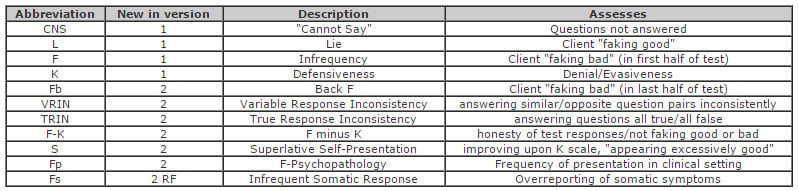
Abbreviation New in version Description Assesses
CNS 1 “Cannot Say” Questions not answered
L 1 Lie Client “faking good”
F 1 Infrequency Client “faking bad” (in first half of test)
K 1 Defensiveness Denial/Evasiveness
Fb 2 Back F Client “faking bad” (in last half of test)
VRIN 2 Variable Response Inconsistency answering similar/opposite question pairs inconsistently
TRIN 2 True Response Inconsistency answering questions all true/all false
F-K 2 F minus K honesty of test responses/not faking good or bad
S 2 Superlative Self-Presentation improving upon K scale, “appearing excessively good”
Fp 2 F-Psychopathology Frequency of presentation in clinical setting
Fs 2 RF Infrequent Somatic Response Over reporting of somatic symptoms
The “Cannot Say” Scale (“? scale”)
The “?” scale is simply the number of omitted items (including items answered both true and false). The MMPI-2 manual suggests that protocols with 30 or more omitted items should be considered invalid and not interpreted. Other experts suggest interpreting with great caution protocols with more than 10 omitted items and not to interpret at all those with more than 30 omitted items.
L Scale
The L scale originally was constructed to detect a deliberate and rather unsophisticated attempt on the part of the respondent to present him/herself in a favorable light. People who present high L scale scores are not willing to admit even minor shortcomings, and are deliberately trying to present themselves in a very favorable way. Better educated, brighter, more sophisticated people from higher social classes tend to score lower on the L scale.
F Scale
The F Scale originally was developed to detect deviant or atypical ways of responding to test items. Several of the F Scale items were deleted from the MMPI-2 because of objectionable content, leaving the F Scale with 60 of the original 64 items in the revised instrument. The F Scale serves three important functions:
1. It is an index of test-taking attitude and is useful in detecting deviant response sets (i.e. faking good or faking bad).
2. If one can rule out profile invalidity, the F Scale is a good indicator of degree of psychopathology, with higher scores suggesting greater psychopathology.
3. Scores on the F Scale can be used to generate inferences about other extratest characteristics and behaviors.
K Scale
Compared to the L Scale, the K Scale was developed as a more subtle and more effective index of attempts by examiners to deny psychopathology and to present themselves in a favorable light or, conversely, to exaggerate psychopathology and to try to appear in a very unfavorable light. Some people refer to this scale as the “defensiveness” indicator, as high scores on the K Scale are thought to be associated with a defensive approach to the test, while low scores are thought to be indicative of an unusually frank and self-critical approach.
Subsequent research on the K Scale has indicated that the K Scale is not only related to defensiveness, but is also related to educational level and socioeconomic status, with better- educated and higher socioeconomic-level subjects scoring higher on the scale. It is not unusual for college-educated persons who are not being defensive to obtain T-scores on the K Scale in a range of 55 to 60, and persons with even more formal education to obtain T-scores in a range of 60 to 70. Moderate elevations on the K Scale sometimes reflect ego strength and psychological resources.
Back F (Fb) Scale
The Fb scale consists of 40 items on the MMPI-2 that no more than 10 percent of the MMPI-2 normative sample answered in the deviant direction. It is analogous to the standard F scale except that the items are placed in the last half of the test. An elevated Fb scale score could indicate that the respondent stopped paying attention to the test items that occurred later in the booklet and shifted to an essentially random pattern of responding.
VRIN Scale (Variable Response Inconsistency)
The VRIN scale was developed for the MMPI-2 as an additional validity indicator. It provides an indication of the respondents’ tendencies to respond inconsistently to MMPI-2 items, and whose resulting protocols therefore should not be interpreted. It consists of 67 pairs of items with either similar or opposite content. Each time a person answers items in a pair inconsistently, one raw score point is added to the score ont he VRIN scale. It is suggested that a raw score equal to or greater than 13 indicates inconsistent responding that probably invalidates the resulting protocol, although this scale is still experimental.
TRIN Scale (True Response Inconsistency)
The TRIN scale was developed to identify persons who respond inconsistently to items by giving true responses to items indiscriminately or by giving false responses to items indiscriminately. The TRIN scale consists of 23 pairs of items that are opposite in content. Two true responses to some item pairs or two false responses to other item pairs would indicate inconsistent responding. The MMPI-2 manual suggests that as rough guidelines TRIN raw scores of 13 or more or of 5 or less may be suggestive of indiscriminate responding that might invalidate the protocol, however, this scale is still considered experimental.
Additional Condition Names and Codes of the MMPI-2 Content Scales
Anxiety (ANX)
Fears (FRS)
Obsessiveness (OBS)
Depression (DEP)
Health Concerns (HEA)
Bizarre Mentation (BIZ)
Anger (ANG)
Cynicism (CYN)
Antisocial Practices (ASP)
Type A (TPA)
Low Self-Esteem (LSE)
Social Discomfort (SOD)
Family Problems (FAM)
Work Interference (WRK)
Negative Treatment Indicators (TRT)
Guidelines for Interpreting Addiction Potential Indicators MAC-R (MacAndrew Alcoholism–Revised)
Scale APS (Addiction Potential Scale)
AAS (Addiction Admission Scale)
The Personality Psychopathology Five (PSY-5) Scales
Aggressiveness (AGGR)
Psychoticism (PSYC)
Disconstraint (DISC)
Negative Emotionality (NEGE)
Introversion/Low Positive Emotionality (INTR)
Understanding of the MMPI-2 Content Scales
The following is a brief description of the characteristics typical of high scorers for each of the MMPI-2 Content Scales. People with a low score in these areas can assume the opposite of the descriptions. Therapy suggestions of the Hypnosis on this site are offered for consideration as a treatment modality to any clinical qualities you might discover about yourself.
Anxiety (ANX):
High scoring individuals on this scale report general symptoms of anxiety including tension, somatic problems, sleep difficulties, worries, and poor concentration. They fear losing their minds, find life to be a strain, and have difficulty making decisions. They appear to be readily aware of these symptoms and problems and are willing to admit to them.
Fears (FRS):
A high score on FRS suggests an individual with many specific fears. These specific fears can include blood; high places; money; animals such as snakes, mice, or spiders; leaving home; fire; storms and natural disasters; water; the dark; being indoors; and dirt.
Obsessiveness (OBS):
High scorers on OBS have great difficulties making decisions. They are likely to ruminate excessively about issues and problems, causing others to become impatient. They do not like to make changes, and they may report some compulsive behaviors like counting or saving unimportant things. They worry excessively and frequently become overwhelmed by their own thoughts.
Depression (DEP):
High scores on DEP indicate individuals with significant depressive thoughts. They report feeling blue, uncertain about their future, and uninterested in their lives. They are likely to brood, be unhappy, cry easily, and feel hopeless and empty. They may report thoughts of suicide or wishes that they were dead. They may believe that they are condemned or that they have committed unpardonable sins. Other people may not be viewed as a source of support.
Health Concerns (HEA):
Individuals with high scores on this scale show many physical symptoms across several body systems. Included are gastro-intestinal symptoms (e.g., constipation, nausea and vomiting, and stomach trouble), neurological problems (e.g., convulsions, dizziness and fainting spells, and paralysis), sensory problems, cardiovascular symptoms (e.g., heart or chest pains), skin problems, pain, and respiratory troubles. They worry about their health and feel sicker than most people.
Bizarre Mentation (BIZ):
Psychotic thought processes characterize people who score high on the BIZ scale. They may report auditory, visual, or olfactory hallucinations and may recognize that their thoughts are strange and peculiar. Paranoid ideation (e.g., the belief that they are being plotted against or that someone is trying to poison them) may be reported as well. These individuals may feel that they have a special mission or powers.
Anger (ANG):
Individuals who score high on the ANG scale report problems in anger control. These individuals report being irritable, grouchy, impatient, hotheaded, annoyed, and stubborn. They sometimes feel like swearing or smashing things. They may lose control and report having been physically abusive towards people and objects.
Cynicism (CYN):
High scores on CYN are associated with misanthropic beliefs. These individuals expect hidden, negative motives behind the acts of others (e.g., believing that most people are honest simply for fear of being caught). They believe other people are to be distrusted, for people use each other and are only friendly for selfish reasons. They likely hold negative attitudes about those close to them, including fellow workers, family, and friends.
Antisocial Practices (ASP):
In addition to holding misanthropic attitudes like the high scorers on the CYN scale, individuals who score high on the ASP scale report problem behaviors during their school years and other antisocial practices such as being in trouble with the law, stealing, or shoplifting. They acknowledge sometimes enjoying the antics of criminals and believe that it is acceptable to get around the law, as long as it is not broken.
Type A (TPA):
People who score high on TPA report being hard-driving, fast-moving, and work- oriented individuals who frequently become impatient, irritable, and annoyed. They do not like to wait or to be interrupted. There is never enough time for them to complete their tasks. They are direct and may be overbearing in their relationships with others.
Low Self-Esteem (LSE):
High scores on LSE suggest that these individuals have low opinions of themselves. They do not feel important or liked by others. They hold many negative attitudes about themselves, including beliefs that they are unattractive, awkward and clumsy, useless, and a burden to others. They lack self-confidence and find it hard to accept compliments from others. They may be overwhelmed by all the faults they see in themselves.
Social Discomfort (SOD):
People who score high on SOD are very uneasy around others, preferring to be by themselves. In social situations, they are likely to sit alone rather than joining the group. They see themselves as shy and they dislike parties and other group events.
Family Problems (FAM):
Family discord is reflected in high scores on FAM. High scorers describe their families as loveless, quarrelsome, and unpleasant. They even may report hating family members. They portray their childhood as abusive, and marriages are seen as unhappy and lacking in affection.
Work Interference (WRK):
Those who score high on WRK report behaviors or attitudes likely to contribute to poor work performance. Some of the problems relate to low self-confidence, concentration difficulties, obsessiveness, tension and pressure, and decision-making problems. Others suggest lack of family support for their career choice, personal questioning of career choice, and negative attitudes towards co-workers.
Negative Treatment Indicators (TRT):
High scores on TRT indicate individuals who have negative attitudes toward doctors and mental health treatment. High scorers do not believe that anyone can understand or help them. They have issues or problems that they are not comfortable discussing with anyone. They may not want to change anything in their lives, nor do they feel that change is possible. They prefer giving up rather than facing a crisis or difficulty.
Description of the PSY-5 Scales
The Personality Psychopathology Five (PSY-5) Scales Harkness, McNulty, Ben-Porath, and Graham (2002) described the Psychopathology Five (PSY-5) scales for the MMPI-2. The selection of the PSY-5 constructs was based on research to determine how lay people classified or discriminated personality characteristics or personality problems (Harkness, 1992). The items used in the initial analyses were derived from the selective diagnostic criteria from the DSM-III-R, from personality disorders as described by Cleckley (1982) as a means of describing severe personality disorders, psychopaths, and 26 clusters were developed from the primary factors of Tellegen s MPQ. These initial clusters contained items that were found to measure five distinct personality dimensions. These measures were then refined to be assessed by items on the MMPI-2in order to address the following characteristics as noted by Harkness et al.:
Aggressiveness (AGGR):
This scale measures offensive and instrumental aggression and not reactive aggression. Individuals high on this scale tend to intimidate others and use aggression as a means of accomplishing their goals. PSY-5 high AGGR scorers show characteristics of dominance and hate.
Psychoticism (PSYC):
This scale assesses mental disconnection from reality and focuses upon unusual sensory and perceptual experiences, delusional beliefs, and other odd behaviors. Alienation and unrealistic expectation of harm is also characteristic of persons high on this scale. People with high PSYC scores tend to have a higher probability of experiencing delusions of reference, disorganized thinking, bizarre behavior, and disoriented, circumstantial, or tangential thought processes. Inpatients with high scores on PSYC have been found to be more likely to be diagnosed as being psychotic for example showing paranoid suspiciousness, ideas of reference, loosening of associations, hallucination, or flight of ideas.
Disconstraint (DISC):
Persons high on this scale show (a) higher levels of physical risk- taking, (b) have a style characterized more by impulsivity than control, and (c) are less bound by traditional moral constraints. High scorers tend to have difficulty “creating mental models of the future that contain negative emotional cues, that is, do not seem to learn from punishing experiences.” They tend to be high risk-takers and show an impulsive and less traditional life style. They tend to be easily bored with routine.
Negative Emotionality/Neuroticism (NEGE):
This scale focuses on problematic features of processing incoming information, for example, to worry, to be self-critical, to feel guilty, and to develop worst-case scenarios are common features. Introversion/Low Positive Emotionality (INTR): High scorers show little capacity to experience joy and positive engagement. They have low “hedonic capacity.” They tend to be introverted and depressed.
Guidelines for Interpreting Addiction Potential Indicators
The MAC-R, APS, and AAS addiction scales can be used together to more effectively identify substance abusers from normal individuals than any of the scales alone. The APS operates in a manner similar to the MAC-R Scale in that it assesses lifestyle problems and characteristics associated with the development of habit disorders such as alcohol and drug use or abuse. Individuals endorsing the behaviors assessed by these scales show a strong tendency to develop negative habits even though they may not, at present, be alcoholics or drug abusers. A low score on the AAS takes on special meaning in the context of known alcohol or drug problems or when the individual has a very high score on the APS or the MAC-R. If substance abuse problems are likely and awareness or acknowledgment of the problems is low, the individual’s motive in the assessment is questioned.
The following is a brief description of the interpretive potential for each of the three addiction scales.
MAC-R (MacAndrew Alcoholism-Revised) Scale:
This measure is a 49-item scale developed with the original MMPI to distinguish alcoholic psychiatric patients from nonalcoholic psychiatric patients. A high MAC-R Scale score is associated with substance abuse potential and other addictive problems such as pathological gambling. A T score cutoff of 60 on the MAC-R Scale is suggestive of high addiction potential. The scale was constructed empirically, using methods similar to those employed in the construction of the APS discussed below.
APS (Addiction Potential Scale):
The Addiction Potential Scale was developed as a measure of the personality characteristics and life situations associated with substance abuse. Research data for this purpose were obtained from three large samples collected as part of the MMPI Restandardization Project: the MMPI-2 normative sample, a sample of psychiatric inpatients, and a sample of inpatient residents of a substance-abuse treatment program. Every MMPI-2 item was examined for its potential to improve discrimination over the original MMPI items. A total of 39 items comprise the Addiction Potential Scale.
AAS (Addiction Acknowledgment Scale):
The development of the AAS began with a rational search through the MMPI-2 item pool for items with content indicating substance-abuse problems. Fourteen such items were found. Items not contributing to internal consistency were dropped and replaced by two items that improved scale internal consistency. The Addiction Acknowledgment Scale is made up of 13 items. Research has shown that both the APS and the AAS discriminate well between substance abuse samples and samples of either psychiatric patients or normals. In addition they discriminate between samples considerably more effectively than MAC-R.
The AAS assesses the frank acknowledgment of alcohol or drug abuse problems. Individuals who obtain elevations on this scale are acknowledging problems with alcohol or drug use. A T-score of 60 or higher reflects an awareness of their substance use or abuse problems and their openness to discussing their problems. Low scores on the AAS can mean one of two things: either there is no substance abuse problem or the individual is denying such problems.
How to Read Your MMPI Profile
If you have your MMPI results in front of you, don’t start by looking for the biggest number. Instead, work through the profile in a logical order so that you understand what the different parts are telling you.
Step 1: Look at the Validity Scales
Start with the validity information. This helps determine whether the response pattern appears consistent enough for the rest of the profile to be interpreted.
If there are significant concerns about the validity of the responses, the other scores may need to be viewed with caution.
Step 2: Look at the Overall Profile
Next, look at the profile as a whole. Which scores are higher? Which are lower? Are several scores elevated, or is there only one obvious elevation?
Looking at the overall shape of the profile can tell you more than immediately focusing on the highest number.
Step 3: Look at Your T-Scores
Look at the T-score beside each scale and remember that the number is not a percentage.
A T-score is simply a standardized way of showing where your result falls within the MMPI scoring system.
Step 4: Look for Elevated Scores
Look for scores that are noticeably higher than the reference level. However, don’t assume that every elevated score means there is a problem.
The scale involved, the size of the elevation and the rest of the profile all matter.
Step 5: Compare Related Scores
If your report includes Clinical, RC, Content and Supplementary Scales, look at them together. Different scales can provide additional information about similar areas without measuring exactly the same thing.
This can help explain why an MMPI report contains several different scores that appear to relate to the same general subject.
Step 6: Consider Why the Test Was Taken
The reason someone takes an MMPI can also matter. The test can be used in different professional settings, including clinical and certain employment or forensic assessments.
The type of report and the way the results are interpreted can therefore depend partly on the purpose of the assessment.
Step 7: Don’t Diagnose Yourself From One Number
This is perhaps the most important step. Don’t take one high score and search for a diagnosis based on that number alone.
The MMPI is designed to produce a profile, and the relationship between the different scores is an important part of understanding what the overall result means.
How MMPI Scores Work Together
Imagine that one person has a high score on one scale but relatively average scores everywhere else. Another person might have several related elevated scores.
Those two profiles could be very different even though they share one high score.
This is why professional interpretation looks at the pattern rather than simply identifying the highest number. One score can provide a clue, but the complete profile provides the bigger picture.
Practice the MMPI 2 Online
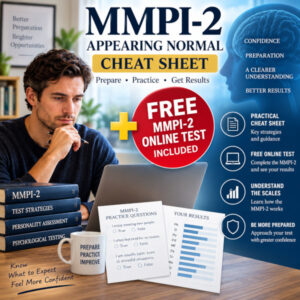
Want to practice the MMPI-2 before taking the real test? For just $1.99, you can get access to the MMPI Online Test and Results and use it as many times as you wish for over a Month.
FREE when you purchase the Appearing Normal Cheat Sheet
Practice the MMPI-2 online, review your results and become better prepared before taking an actual MMPI-2 assessment.
The test includes both the questions and your results. Please note that this is a practice and self-analysis resource and does not provide professional psychological analysis or interpretation.
Prepare, practice and understand the MMPI-2 for less than the price of a cup of coffee.