

About the MMPI 2 | Minnesota Multiphasic Personality Inventory
The MMPI 2 Test online, commonly known as the MMPI, is a psychological assessment designed to examine patterns of personality and psychological functioning. The MMPI is one of the best-known personality assessment instruments and has been developed and revised over many decades.
The original MMPI was developed at the University of Minnesota by Starke R. Hathaway and J. Charnley McKinley. The first version was published in 1943, and the first major revision, the MMPI-2, was published in 1989. The MMPI-2 was subsequently revised and updated, including the introduction of the Restructured Clinical Scales in 2003 and the Symptom Validity Scale in 2006.
This page provides an overview of the MMPI, including the history of the MMPI test, the development of the MMPI-2, MMPI questions, MMPI scales, MMPI scores, MMPI norms and the different versions of the MMPI.
Uses of the MMPI2
The MMPI-2 test’s contemporary normative sample and extensive research base help make it the gold standard in assessment for a wide variety of settings. The test can be used to help:
1) Assess major symptoms of social and personal maladjustment.
2) Identify suitable candidates for high-risk public safety positions.
3) Give a strong empirical foundation for a clinician’s expert testimony
4) Assess medical patients and design effective treatment strategies.
5) Evaluate participants in substance abuse programs and select appropriate treatment approaches.
6) Support college and career counseling recommendations.

What Is the MMPI?
MMPI stands for Minnesota Multiphasic Personality Inventory.
The MMPI is a self-report psychological test. A person taking the MMPI answers a large number of questions about themselves, their experiences, feelings, attitudes and behaviors. The responses are then scored across a range of scales.
The original MMPI was developed using an empirical approach to test construction. The developers used responses from different groups of people to identify questions that could help distinguish between groups. This approach was different from personality tests that were developed primarily from a particular theory of personality.
The original MMPI became widely used, but its original normative sample and some of its terminology eventually became outdated. Changes in psychological research and the need for a more representative normative sample contributed to the development of the MMPI-2.
What Is the MMPI-2?
The MMPI-2 is the first major revision of the original MMPI. It was published in 1989 and standardized using a new national sample of adults in the United States. The University of Minnesota currently describes the MMPI-2 as a 567-item self-report instrument for adults aged 18 and older.
The MMPI-2 can be administered by computer or using paper-and-pencil. The official administration time is approximately 60 to 90 minutes.
The MMPI-2 contains more than 120 scales and includes validity indicators, Clinical Scales, Restructured Clinical Scales, Content Scales, Content Component Scales, Supplementary Scales and Clinical Subscales.
MMPI Test: How Does It Work?
The MMPI test uses a large number of questions to produce a profile of scores across different scales.
The standard MMPI-2 uses True-False questions. The person taking the test indicates whether each statement is true or false as it applies to them. The individual answers are then scored according to the MMPI-2 scoring system.
An MMPI profile is not simply a list of questions that have been answered correctly or incorrectly. The interpretation depends on patterns of responses across multiple scales.
The MMPI also includes validity indicators. These provide information about the characteristics and consistency of the response pattern and are an important part of interpreting an MMPI-2 profile.
How Many Questions Are on the MMPI-2?
The standard MMPI-2 contains 567 True-False items. The official MMPI-2 administration time is approximately 60 to 90 minutes, although the actual time can vary between individuals.
The MMPI-2 was designed for adults aged 18 and older and has a minimum reading level of approximately fifth grade according to the University of Minnesota’s current product information.
The large number of MMPI questions allows the test to examine many different areas and produce scores across a large number of scales.
What Are the MMPI Questions?
MMPI questions cover a wide range of subjects. They can relate to physical experiences, emotions, thoughts, attitudes, relationships, behaviors and everyday situations.
Some questions may appear unrelated to one another when taking the test. This is because the MMPI does not rely on a small number of obvious questions to assess a particular characteristic. Instead, patterns across many responses contribute to scores on different scales.
The questions also contribute to the validity scales, which are used when determining whether the resulting MMPI profile can be interpreted appropriately.
For more information about the questions, see our dedicated MMPI Questions page.
What Does the MMPI Measure?
The MMPI was developed to provide information about patterns of personality and psychological functioning. The MMPI-2 can be used to aid assessment across a wide range of clinical conditions and is also used in certain nonclinical settings, including some public-safety and forensic applications.
The MMPI-2 does not consist of one single score. Instead, it produces scores across numerous scales.
These include measures relating to psychological symptoms, personality characteristics, emotional functioning, interpersonal behavior and other areas of psychological functioning.
The meaning of an individual score depends on the scale involved, the rest of the MMPI profile, the validity indicators and the purpose for which the assessment was administered.
About the MMPI 2 Product Summary
| Administration: Paper-and-pencil, CD, or c Computer administration | Administer to: Individuals 18 years and older |
| Completion Time: 60-90 minutes (567 true/false items) | Publication Date: 1989, revised 2001 |
| Language: English Spanish French for Canada |
Relevant to a range of contemporary applications, the MMPI-2 instrument remains the most widely used and widely researched test of adult psychopathology. Used by clinicians to assist with the diagnosis of mental disorders and the selection of appropriate treatment methods, the MMPI-2 test continues to help meet the assessment needs of mental health professionals in an ever-changing environment.
About the MMPI: Key Features
1) Descriptive and diagnostic information relevant to today’s clients.
2) Tailored reports present interpretive information for specific settings.
3) Nationally representative normative sample.
4) Normative sample consists of 1,138 males and 1,462 females between the ages of 18 and 80 from several regions and diverse communities within the U.S.
5) Flexible administration and scoring.
What Are MMPI Scales?
One of the defining characteristics of the MMPI is its large number of scales.
The current MMPI-2 consists of more than 120 scales, including validity indicators, Clinical Scales, Restructured Clinical Scales, Content Scales, Content Component Scales, Supplementary Scales and Clinical Subscales.
MMPI-2 Validity Scales
Validity scales are an important part of the MMPI-2. They provide information about the characteristics and consistency of a person’s responses.
The MMPI-2 validity indicators include:
- ? or CNS, Cannot Say
- VRIN, Variable Response Inconsistency
- TRIN, True Response Inconsistency
- F, Infrequency
- FB, Back F
- FP, Infrequency-Psychopathology
- FBS, Symptom Validity
- L, Lie
- K, Correction
- S, Superlative Self-Presentation
These scales help provide information about the response pattern before the substantive scales are interpreted.
MMPI-2 Clinical Scales
The traditional MMPI-2 Clinical Scales are numbered 1 through 9, with Scale 0 also included.
They are:
| Scale | Name |
|---|---|
| 1 Hs | Hypochondriasis |
| 2 D | Depression |
| 3 Hy | Hysteria |
| 4 Pd | Psychopathic Deviate |
| 5 Mf | Masculinity-Femininity |
| 6 Pa | Paranoia |
| 7 Pt | Psychasthenia |
| 8 Sc | Schizophrenia |
| 9 Ma | Hypomania |
| 0 Si | Social Introversion |
These are historical MMPI scale names. They should not simply be treated as modern diagnostic labels based on an individual score.
MMPI-2 Restructured Clinical Scales
The Restructured Clinical, or RC, Scales were introduced as an important later development of the MMPI-2.
The RC Scales include:
- RCd, Demoralization
- RC1, Somatic Complaints
- RC2, Low Positive Emotions
- RC3, Cynicism
- RC4, Antisocial Behavior
- RC6, Ideas of Persecution
- RC7, Dysfunctional Negative Emotions
- RC8, Aberrant Experiences
- RC9, Hypomanic Activation
These scales are included in the MMPI-2 extended scoring system.
MMPI-2 Content Scales
The MMPI-2 Content Scales provide additional information about particular areas of psychological functioning.
They include:
- ANX, Anxiety
- FRS, Fears
- OBS, Obsessiveness
- DEP, Depression
- HEA, Health Concerns
- BIZ, Bizarre Mentation
- ANG, Anger
- CYN, Cynicism
- ASP, Antisocial Practices
- TPA, Type A
- LSE, Low Self-Esteem
- SOD, Social Discomfort
- FAM, Family Problems
- WRK, Work Interference
- TRT, Negative Treatment Indicators
The MMPI-2 also contains Content Component Scales that provide more detailed information within several of these areas.
MMPI-2 Supplementary Scales
The MMPI-2 supplementary scales provide additional information that can be considered alongside the primary MMPI scales.
Examples include:
- AGGR, Aggressiveness
- PSYC, Psychoticism
- DISC, Disconstraint
- NEGE, Negative Emotionality/Neuroticism
- INTR, Introversion/Low Positive Emotionality
Additional supplementary scales include measures of areas such as anxiety, repression, ego strength, dominance, social responsibility, hostility, addiction-related characteristics and other areas.
For a more detailed explanation of the individual scales, see our MMPI Scales guide.
What Are MMPI Scores?
MMPI scores are standardized scores that allow a person’s responses to be compared with appropriate normative data.
The MMPI-2 uses several types of scores and profiles. The particular scores presented depend on the scoring system and report being used.
The Extended Score Report, for example, includes information from the Restructured Clinical Scales as well as traditional Clinical Scales, Content Scales, Supplementary Scales and other subscales.
An MMPI score should not normally be interpreted on its own. The complete profile, validity indicators and purpose of the assessment are important when interpreting MMPI results.
For more information, see our MMPI Scores and MMPI Test Results pages.
What Are MMPI Norms?
MMPI norms provide the reference population used when interpreting standardized scores.
The MMPI-2 normative sample consists of 2,600 adults, including 1,138 males and 1,462 females between the ages of 18 and 80. Participants were drawn from several regions and diverse communities within the United States.
The MMPI-2 also has non-gendered T-score options in certain reports. The scoring system and report being used determine which scores and norms are provided.
Normative data are important because an MMPI score has meaning in relation to an appropriate reference population.
Practice the MMPI 2 Online
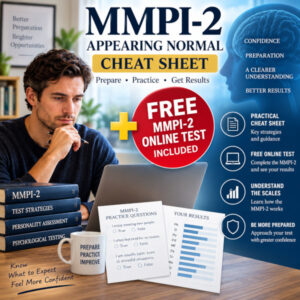
Want to practice the MMPI-2 before taking the real test? For just $1.99, you can get access to the MMPI Online Test and Results and use it as many times as you wish for over a Month.
FREE when you purchase the Appearing Normal Cheat Sheet
Practice the MMPI-2 online, review your results and become better prepared before taking an actual MMPI-2 assessment.
The test includes both the questions and your results. Please note that this is a practice and self-analysis resource and does not provide professional psychological analysis or interpretation.
Prepare, practice and understand the MMPI-2 for less than the price of a cup of coffee.